Starting at
$25/m
- Virtual Office
- Professional Address
- Local, dedicated Number
- Mail & Package Receipt
- Answering Service Bundles
Virtual Office & Telephone Answering: Solutions
BSSI Virtual Offices in New York City and Las Vegas offers Virtual Office Services for identity purposes; or bundled with Automated and /or Live Receptionist Services. BSSI Virtual Offices also offers a stand-alone suite of Telephone Answering and/or Live Receptionist service packages available for New York City, NY, Las Vegas, NV, Chicago, IL and Los Angeles, CA.
BSSI Virtual Offices in New York City and Las Vegas create and maintain a virtual professional presence by handling and routing phone calls and mail. BSSI services allow you to have a physical business address, professional reception staff and corporate phone system communications so you can start, grow and expand your business in a cost-effective and efficient way. BSSI Virtual Offices in New York City and Las Vegas is an affordable substitute to leasing office space or hiring a live receptionist.Â

| Las Vegas | New York City | Chicago | Los Angeles |
| New York City | Las Vegas |
BSSI Virtual Offices services key features are: professional mailing address in New York City; staff to receive your mail and courier packages; free mail pick-up or forwarding (charges apply); Standard and Premium Mail Scan to Email; Local fax number and faxes delivered to your email Inbox; bundled Telephone Answering including: dedicated local area phone number; calls answered by automated system, with dialing extensions options; calls seamlessly routed to your cell through Direct Call to Cell (DCC); Voicemail notifications through electronic file to email; calls scheduled by day and time on your terms through the Call Time Scheduler; Live Receptionists Answering calls, with screening, forwarding and hand typed email message and text message; with a U.S. based receptionists on staff.
The virtual office concept is an offshoot from the executive suites business which is more than 30 years old. Executive space usually requires less capital and time commitment than a lease for one's own office suite; however, the rigidity of an executive suite lease may not work for many business models. Through technologies and innovation allowing one to work anywhere and anytime, along with current mobile employment styles especially the work-from-home concept; the virtual office idea was born.
1. Communications services
Remote Receptionist: Individual(s) in a remote location using Computer Telephone Integration software to replace a traditional in-house receptionist.
Virtual Assistant: Most commonly an individual working from his residence who does not meet clients in person.
Telephone Answering Services: Remote Receptionist service that operates from a central location for receiving and passing on telephone requests.
Voicemail: An electronic system enabling the recording, storage of and listening to voice messages.
Assigned Private Phone Number: Local Number that is uniquely yours while employing a provider's services.
Live Answering: Calls personally answered live in your company during office hours, caller asked for Name, Number and reason for the Call ("Message") Message emailed or texted to you.
Voicemail Message Notification to Email: Voicemail message converted into .wav file and delivered electronically to your inbox.
Music on Hold: Music in background for callers while waiting to connect to dialing option.
Email or Text Message Notification to Cell Phone: When messages taken live, they can be communicated electronically. There is no need to 'dial into voicemail.'
Call Time Scheduler: Calls can be scheduled to be answered a certain way during business hours and a different way after-hours.
2. Space services
Professional Address: A business location to be used as your company address. A professional address eases the privacy and personal security concerns of running a home-based business. A user can expand into new markets by utilizing a provider with multiple locations to establish a professional presence in the desired growth markets.
Mailing address: A physical location to use for contact information and letters, packages, etc., that are sent or delivered by means of the United States Postal System.
Reception Courtesies: Receptionist to personally answer your calls. Staffed location to receive your Federal Express, UPS, etc. envelopes and packages (Size and weight restrictions apply). Collect your mail in person by arrangement or have it sent to you on a set schedule for an additional charge. Don't waste a trip if you don't have mail: call and check what's there. Get notified of every package/envelope we sign for.
Business Meeting Space: Hourly, daily or weekly on-demand use of on-site office and/or conference rooms for meetings. Packaged or hourly, daily or weekly. Offerings vary by location.
Executive suite: Lease physical space full-time.
On-site amenities: Vary by location. Examples include high speed internet; conference room use; housekeeping; 24/7 secured access; fax, scan & copy machine; phone and furniture; coffee and water service and utilities.
A Virtual Office keeps office expense low, while retaining the representation of a traditional high-cost office. It allows for low-cost expansion while reducing/eliminating the routine load of health care, accountants, legal records, payroll, sick days, vacations, personal leaves, etc.-because that does not apply to a virtual staff.
Every business type can benefit from virtual office and telephone answering service! Entrepreneurs, roofers, electricians, plumbers, landscapers, construction contractors, repair/remodel, accountants, attorneys, doctors/dentists, therapists, business consultants, marketers, real estate agents…businesses large and small can utilize business address and automated and/or live answering telephone answering services.
New York is the most heavily populated city in the United States of America. It is the center of the New York Metropolitan Area, and is referred to as "New York City." Also known as "The City of New York," New York has a significant impact upon every industry type, such as commerce, finance, education; new media as well as traditional media, advertising, legal services, accountancy, insurance, theater, fashion and the arts. Home to the United Nations Headquarters, New York is an important center for international diplomacy and is also described as the "cultural capital of the world".
New York City consists of five boroughs, each of which comprises a county. The five boroughs - The Bronx, Brooklyn, Manhattan, Queens, and Staten Island - all became one city in 1898. The 2011 Census estimated the population over 8million over a land area of 305 square miles, making New York the most densely populated major city in the United States. With over 800 languages spoken by its inhabitants, New York is the most linguistically diverse city on the Earth.
New York's roots go back to 1624 as a trading post by the Dutch colonists. It was named New Amsterdam in 1626 and fell to English control in 1664 when it was renamed New York after the King's brother, the Duke of York, who was granted the rights to it. New York served as the capital of the United States from 1785 - 1790. Located on one of the world's largest natural harbors, the Statue of Liberty presides over its mouth and is a globally recognized symbol of the United States and its democracy.
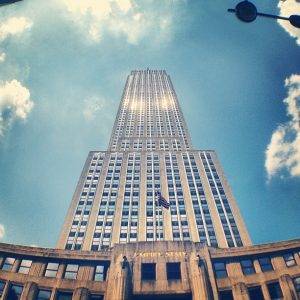
More than 50 million people visit the city annually from all parts of the globe. Times Square, aka as "The Crossroads of the World", is the hub of the Broadway theater district, perhaps the world's busiest pedestrian intersections, and a major center of the world's entertainment industry. Nearby is the Empire State Building, one of the many world renowned skyscrapers, on Fifth Avenue. New York City's financial district, infamous Wall Street, functions as the financial capital of the world and is home to the New York Stock Exchange, the world's largest stock exchange by total market capitalization of its listed companies.
The real estate market is among the most expensive in the world and is a major force in the city's economy: total value of all New York City property was $802.4 billion in 2006. Chinatown in Manhattan has the highest concentration of Chinese people in the Western Hemisphere. With continuous 24/7 service, the New York City Subway is one of the world's most extensive rapid transit systems. Among the world's top ranking colleges and universities are located in New York, including Columbia University, New York University, and Rockefeller University.
Located in the Northeastern United States in the southeastern New York State halfway between Washington, D.C. and Boston, New York City is at the mouth of the Hudson River, which feeds into a naturally sheltered harbor and then into the Atlantic Ocean. Its location has helped the city grow in significance as a trading city. Much of New York is built on the scarce land of three islands of Manhattan, Staten Island, and Long Island, encouraging a high population density.
The Hudson River flows through the Hudson Valley into New York Bay, separating it from the state of New Jersey. The East River is a strait which flows from Long Island Sound and separates the Bronx and Manhattan from Long Island. The Harlem River, another tidal strait between the East and Hudson Rivers, separates most of Manhattan from the Bronx. The Bronx River, which flows through the Bronx and Westchester County, is the only entirely fresh water river in the city.
The city's total area is approx. 470 square miles, of which 35% is water and the remainder is land. The highest point in the city is Todt Hill on Staten Island, which is approx. 410 feet above sea level and is also the highest point on the Eastern Seaboard south of Maine.
New York City has been ranked first among the 120 global cities in attracting capital, business, and tourists. It is a hub of international business and commerce and one of the "command centers" for the world economy. The New York metropolitan area had approximately gross metropolitan product of $1.28 trillion in 2010, making it the largest regional economy in the United States and, according to IT Week, the second largest city economy in the world.
Many major corporations are headquartered in New York City, including 45 Fortune 500 companies. New York is also unique among American cities for its large number of foreign corporations. One out of ten private sector jobs in the city is with a foreign company.
Second only to Hollywood is New York City's television and film industry. High-tech industries like software and game development and internet services are also growing, benefitting by the city's position at the terminus of many transatlantic fiber-optic trunk lines. Other important sectors include medical research and technology, non-profit institutions, and universities. The food-processing industry is a stable major manufacturing sector in the city. Food- making is a $5 billion industry that employs 19,000+ residents. Chocolate is New York City's leading specialty-food export.
Mass transit in New York City runs 24 hours a day. It is the most complex and extensive in North America, with about one in every three users of mass transit in the United States and two-thirds of the nation's rail riders live in the New York City Metropolitan Area.
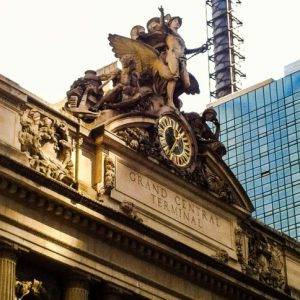
New York City Subway system is 'iconic! It's the largest rapid transit system in the world with 468 stations in operation and by length of routes, and the third-largest when measured by annual ridership (1.5 billion passenger trips in 2006). Grand Central Terminal/ "Grand Central Station" is the world's largest railway station by its number of platforms. New York's airspace is one of the world's busiest air transportation corridors. The George Washington Bridge, connecting Manhattan to Bergen County, New Jersey, is the world's busiest motor vehicle bridge.
More than half of all New Yorkers commute to work using mass transit, in clear contrast to the rest of the country, where about 90% of commuters drive their cars to work. The US Census Bureau reports that New York City residents have the longest commute time in the nation among large cities: averaging 38 minutes a day getting to work. However, the high usage of mass transit means that New Yorkers spend less of their household income on transportation than the national average.
New York City is served by Amtrak, which uses Pennsylvania Station/"Penn Station." Amtrak provides connections along the Northeast Corridor and long-distance train service to other North American cities. The Port Authority Bus Terminal, the main intercity bus terminal of the city, serves 7,000 buses and 200,000 commuters daily, and it is the busiest bus station in the world.
New York City's transportation system also includes the longest suspension bridge in the Americas and one of the world's longest (the Verrazano-Narrows), the world's first mechanically ventilated vehicular tunnel, more than 12,000 yellow cabs, an aerial tramway that transports commuters between Roosevelt Island and Manhattan, and a ferry system connecting Manhattan to various locales within and outside the city. The Staten Island Ferry is the US' busiest ferry, carrying over 19 million passengers annually on its 5.2-mile run between Staten Island and Lower Manhattan. The Staten Island Railway rapid transit system solely serves Staten Island. The Port Authority Trans-Hudson/"PATH" train links Midtown and Lower Manhattan to northeastern parts of the state New Jersey.
New York City's public bus and commuter rail network are the largest in North America. The rail network, connecting the suburbs in the tri-state region to the city, consists of the Long Island Rail Road, Metro-North Railroad and New Jersey Transit. These systems come together at Grand Central Terminal and Pennsylvania Station.
Although New York heavily relies on public transit, the roads and streets are instrumental in the founding, growth and workings of the city. Manhattan's street grid plan influenced the city's physical development. Several of the city's streets and avenues, for example Broadway, Wall Street, and Seventh Avenue are also used as synonyms for industries located there: the theater, finance, and fashion organizations, respectively. New York City has a widespread network of expressways and parkways linking New York City to Northern New Jersey, Westchester County, Long Island, and the southwest area of Connecticut through various bridges and tunnels.
New York City is served by three major airports: John F. Kennedy International; Newark Liberty International, and LaGuardia; 100 million travelers used the three airports in 2005, and the city's airspace is the busiest in the nation. Outbound international travel from JFK and Newark accounts for approx 25% of all U.S. travelers who travel overseas.
New York City is located in the Northeastern United States, in southeastern New York State, approximately halfway between Washington, D.C. and Boston. The location at the mouth of the Hudson River, which feeds into a naturally sheltered harbor and then into the Atlantic Ocean, has helped the city grow in significance as a trading city. Much of New York is built on the three islands of Manhattan, Staten Island, and Long Island, making land scarce and encouraging a high population density.
Since 1898, New York City has been a metropolitan municipality with a mayor-council form of government, more centralized than that of most other U.S. cities. In NYC, the central government is responsible for public education, correctional institutions, libraries, public safety, recreational facilities, sanitation, water supply and welfare services. The New York City Council is a unicameral body consisting of 51 Council members whose districts are defined by geographic population boundaries. The mayor and councilors are limited to three consecutive four-year terms but can run again after a four year break. Each borough is coextensive with a judicial district of the New York Supreme Court and hosts other state and city courts.
At the time of this writing, the mayor of New York is Michael Bloomberg
BSSI Virtual Offices services key features are: professional mailing address in Las Vegas; staff to receive your mail and courier packages; free mail pick-up or forwarding (charges apply); Standard and Premium Mail Scan to Email; Local fax number and faxes delivered to your email Inbox; Las Vegas Business license hanging service; bundled Telephone Answering including: dedicated local area phone number; calls answered by automated system, with dialing extensions options; calls seamlessly routed to your cell through Direct Call to Cell (DCC); Voicemail notifications through electronic file to email; calls scheduled by day and time on your terms through the Call Time Scheduler; Live Receptionists Answering calls, with screening, forwarding and hand typed email message and text message; full service conference room and private office for use in the Executive Office Center facility; with a U.S. based receptionists on staff.
The virtual office concept is an offshoot from the executive suites business which is more than 30 years old. Executive space usually requires less capital and time commitment than a lease for one's own office suite; however, the rigidity of an executive suite lease may not work for many business models. Through technologies and innovation allowing one to work anywhere and anytime, along with current mobile employment styles especially the work-from-home concept; the virtual office idea was born.
1. Communications services
Remote Receptionist: Individual(s) in a remote location using Computer Telephone Integration software to replace a traditional in-house receptionist.
Virtual Assistant: Most commonly an individual working from his residence who does not meet clients in person.
Telephone Answering Services: Remote Receptionist service that operates from a central location for receiving and passing on telephone requests.
Voicemail: An electronic system enabling the recording, storage of and listening to voice messages.
Assigned Private Phone Number: Local Number that is uniquely yours while employing a provider's services.
Voicemail Message Notification to Email: Voicemail message converted into .wav file and delivered electronically to your inbox.
Music on Hold: Music in background for callers while waiting to connect to dialing option.
Email or Text Message Notification to Cell Phone: When messages taken live, they can be communicated electronically. There is no need to 'dial into voicemail.'
Call Time Scheduler: Calls can be scheduled to be answered a certain way during business hours and a different way after-hours.
2. Space services
Professional Address: A business location to be used as your company address. A professional address eases the privacy and personal security concerns of running a home-based business. A user can expand into new markets by utilizing a provider with multiple locations to establish a professional presence in the desired growth markets.
Mailing address: A physical location to use for contact information and letters, packages, etc., that are sent or delivered by means of the United States Postal System.
Reception Courtesies: Receptionist to personally answer your calls. Staffed location to receive your Federal Express, UPS, etc. envelopes and packages (Size and weight restrictions apply). Collect your mail in person by arrangement or have it sent to you on a set schedule for an additional charge. Don't waste a trip if you don't have mail: call and check what's there. Get notified of every package/envelope we sign for.
Business Meeting Space: Hourly, daily or weekly on-demand use of on-site office and/or conference rooms for meetings. Packaged or hourly, daily or weekly. Offerings vary by location.
Executive suite: Lease physical space full-time.
On-site amenities: Vary by location. Examples include high speed internet; conference room use; housekeeping; 24/7 secured access; fax, scan & copy machine; phone and furniture; coffee and water service and utilities.
A Virtual Office keeps office expense low, while retaining the representation of a traditional high-cost office. It allows for low-cost expansion while reducing/eliminating the routine load of health care, accountants, legal records, payroll, sick days, vacations, personal leaves, etc.-because that does not apply to a virtual staff.
Every business type can benefit from virtual office and telephone answering service! Entrepreneurs, roofers, electricians, plumbers, landscapers, construction contractors, repair/remodel, accountants, attorneys, doctors/dentists, therapists, business consultants, marketers, real estate agents…businesses large and small can utilize business address and automated and/or live answering telephone answering services.
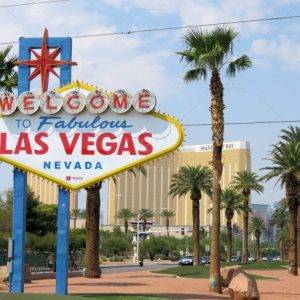
Las Vegas is the most heavily populated city in Nevada. The city is an internationally famous major resort town for gambling, shopping, and fine dining. Self-billed "The Entertainment Capital of the World," it is also a growing retirement and family city. Las Vegas itself has a population of almost 600,000, according to the 2010 census. The 2010 population of the Las Vegas metropolitan area was 1,951,269.
Established in 1905 and incorporated as a city in 1911, Las Vegas' tolerance for various forms of adult entertainment earned it the title of Sin City, and this image has made Las Vegas a popular setting for films and television programs. There are numerous outdoor lighting displays on Fremont Street, and throughout the city.
Located within Clark County in a dry basin on the desert floor of the Mojave Desert, Las Vegas is landlocked, surrounded by mountains. The landscape is rocky and dusty; the environment is dominated by desert vegetation, and the area is subject to heavy flash floods. The elevation is around 2,000+ ft above sea level. The area suffers water resource issues.
The city enjoys abundant sunshine year-round: it has an average of about 300 sunny days per year with more than 3,800 hours of sunshine. Las Vegas' climate is a subtropical desert climate.
June through September months are very hot and mostly dry, with average daytime highs of 94 to 104 °F and night-time lows of 69-78 °F. There are an average of 133 days per year above 90 °F, and 72 days above 100 °F, with most of the days in July and August exceeding that benchmark. Humidity is very low, often under 10%.
The winter months are short and the season is usually mild, with day highs near 60 °F and night lows averaging 40 °F. Snow can be seen on the mountains surrounding Las Vegas, but snow is rare in the Valley itself. Temperatures do drop below 32 °F on very rare occasions.
Annual precipitation in Las Vegas is less than 5 inches, much of which falls in the winter. The wettest month is March, which has on average 4 days of precipitation.
The Las Vegas economy is driven by tourism, gaming, and conventions, which subsequently supply the retail and restaurant industries.The major draws are the casinos and the hotels.
Downtown casinos: Many of the hotel casinos are downtown on the Fremont Street Experience, which has been the focal point of the city's gaming industry since its early days. Las Vegas casinos started in 1931 when the "Northern Club" opened. The most notable of the early casinos was Binion's. Boyd Gaming has a major presence downtown operating hotels and casinos, including the Fremont Hotel and Casino. The Golden Gate Hotel and Casino is the oldest hotel in the Fremont Street Experience. The Golden Nugget is the largest hotel and casino in the city. The Plaza Hotel & Casino on Main Street was the railway station until Amtrak discontinued service.
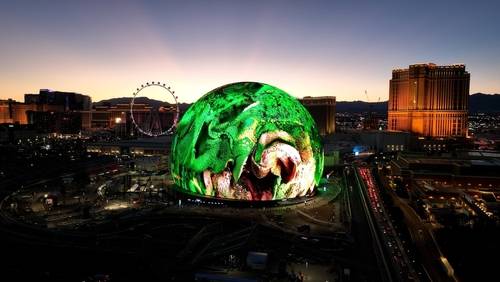
Las Vegas Strip: Undoubtedly the most popular and famous area of town is the resort corridor and 4+ mile stretch of South Las Vegas Boulevard known as "the Strip." The largest and most notable casinos and buildings are located there. The Strip is not located in city limits, but in the surrounding unincorporated Clark County and communities of Paradise and Winchester.
With the opening of the "Mirage" in 1989, a trend of major resort development of the southern portion of the Las Vegas Strip outside of the city began. As the Strip expanded in the 1990s, Downtown Las Vegas (which has maintained an old Las Vegas feel) tourism suffered. The city successfully worked to turn things around: the IRS moved operations downtown; Fremont Street Experience (FSE) was built; Golden Nugget remodeled; the online retailer Zappos moved its headquarters downtown. Unfortunately, the effects of the down turn in the economy have been felt, with many shops closing and high-rise condo projects being halted. One of the highest profile buildings, The Streamline Towers, went into bankruptcy.
The city purchased 61 acres of property from the Union Pacific Railroad in 1995 to create a draw for more people to the downtown area. In 2004 Las Vegas Mayor Oscar Goodman announced plans for Symphony Park, which include residential and office high-rises, the Lou Ruvo Brain Institute (opened 2009), an academic medical center, The Smith Center for the Performing Arts (opened 2012), and a new City Hall (opened). On a lot adjacent to the city's 61 acre site, the World Market Center opened in 2005, a preeminent furniture wholesale showroom and marketplace to compete with the current furniture market capital of High Point, North Carolina.
Above-ground transportation is provided by RTC Transit, the public transportation system offering bus service throughout Las Vegas, Henderson, North Las Vegas, and other suburban areas of the valley. Greyhound, various charter services including Green Tortoise, and several Chinatown bus lines offer inter-city bus service to Las Vegas. Amtrak California operates Deluxe Express Thruway Motorcoach dedicated service between the City and its passenger rail station in Bakersfield, California.
There is a bus transit link called the Strip & Downtown Express (previously ACE Gold Line) with limited stops and frequent service which connects Downtown Las Vegas, the Strip, the Las Vegas Convention Center, and Town Square.
The Union Pacific Railroad is the sole Class I railroad providing rail freight service to Las Vegas.
The City of Las Vegas government operates as a council - manager government. The Mayor sits as a Council member-at-large and presides over all of the City Council meetings. The City Manager is responsible for the administration and the day-to-day operation of all of the municipal services and city departments. The City Manager maintains intergovernmental relationships with federal, state, county, and other local governments.
The Las Vegas metropolitan area is split into neighboring incorporated cities or unincorporated communities. Approximately three quarters of a million people live in unincorporated areas governed by Clark County, and another half million live in incorporated cities such as North Las Vegas, Henderson, and Boulder City. Las Vegas and nearly all of the surrounding metropolitan area share a police department, the Las Vegas Metropolitan Police Department.
Las Vegas, as the county seat and home to the Lloyd D. George Federal District Courthouse, draws numerous legal service industries providing bail, marriage, divorce, tax, incorporation, and other legal services.
At the time of this writing, the mayor of Las Vegas is Carolyn Goodman, the wife of former Mayor of Las Vegas, Oscar Goodman.
BSSI Standalone Automated and /or Live Receptionist Services package options include a private local phone number; calls routed directly to your cell (DCC); calls answered by automated system with up to 7 external dialing extensions; custom greeting; voicemail box; voicemail message to email; Live Answering for reception services; Text Message Notification to Cell Phone; Find Me/Follow Me screening and call announcing; and U.S. based receptionists on staff. All Telephone Answering Services are available for New York City, NY and Las Vegas Nevada.
The idea of using the phonograph to record a telephone conversation was re-invented many times in the early 20th century, perhaps because no commercial telephone recorders appeared on the market (at least in the United States). These inventions were quietly patented, or sometimes loudly announced, but all faded into obscurity almost instantly. For example, in 1925 inventor Truman Stevens (shown here) demonstrated his automatic answering machine, based on cylinder dictation technology. The story was picked up by Popular Science Monthly and other popular magazines, but the product did not succeed.
In the U.S., the telephone company's response to the growing demand for answering machines was to introduce live r live answering services. This consisted of a special switchboard and circuitry that allowed a sort of "call forwarding." Live answering services (which are still available today) were popular among small businesses and doctors. However, the success of the answering services stimulated inventors to develop new answering machines. Under pressure from these inventors, the Federal Communications Commission for the first time permitted the use of automatic answering machines on AT&T lines in 1949, although there were tight restrictions on what technologies could be used and who controlled their use. The Electronic Secretary was one of the first of the postwar answering machines. The original model recorded on wire and used a 45 rpm record as the outgoing message. Later models used two tape transports. Succumbing to customer demand, the Bell System companies and GTE rented this machine to customers by the early 1960s.
There were a large number of answering machines introduced by European or U.S. companies during the 1960s, and for the most part the companies have disappeared or were absorbed by Asian firms. In 1962, Robosonics Inc. of New York introduced the Robosonic Secretary. While expensive (most models cost over $500), the Robosonic machine was extremely rugged and reliable. The Robosonic Secretary was replaced in 1963 by the Robosonics Record-O-Phone. This machine could be remotely accessed by using a whistle called the Telekey, or later an electronic signal generator, held up to the receiver by the user.
At about $500, the Recordo-O-Phone (sold in the early 1970s) was really only practical for businesses.
Other notable machines of the 1960s included the 1964/5 Code-a-Phone Model 500 tape based answering machine, and the later model 700, which was one of the leased machines distributed through AT&T. The Dictaphone corporation in 1965 introduced the Telecord RCME-7, a combination remote dictation unit and answering machine . European companies at this time were introducing very high quality answering machines, such as the Telefunken Model 101F telephone Answering Machine of 1966.
According to ZDnet1, Bridge Ratings says the average phone call is 3 minutes 15 seconds in duration.
With that in mind, here's how our packages compare:
| BSSI Virtual Offices | The Competition | |
| Volume bundled by number of calls/month | Volume bundled by minutes/month | |
| 9-5 Premium Live Answering 100 calls = $89 | 100 minutes = $130 | Average 34 calls |
| 9-5 Premium Live Answering 250 calls = $219 | 250 minutes = $230 | Average 84 calls |
| 9-5 Premium Live Answering 500 calls = $399 | 500 minutes = $400 | Average 134 calls |
| 9-5 Premium Live Answering 750 calls = $579 | 1000 minutes = $750 | Average 334 calls |